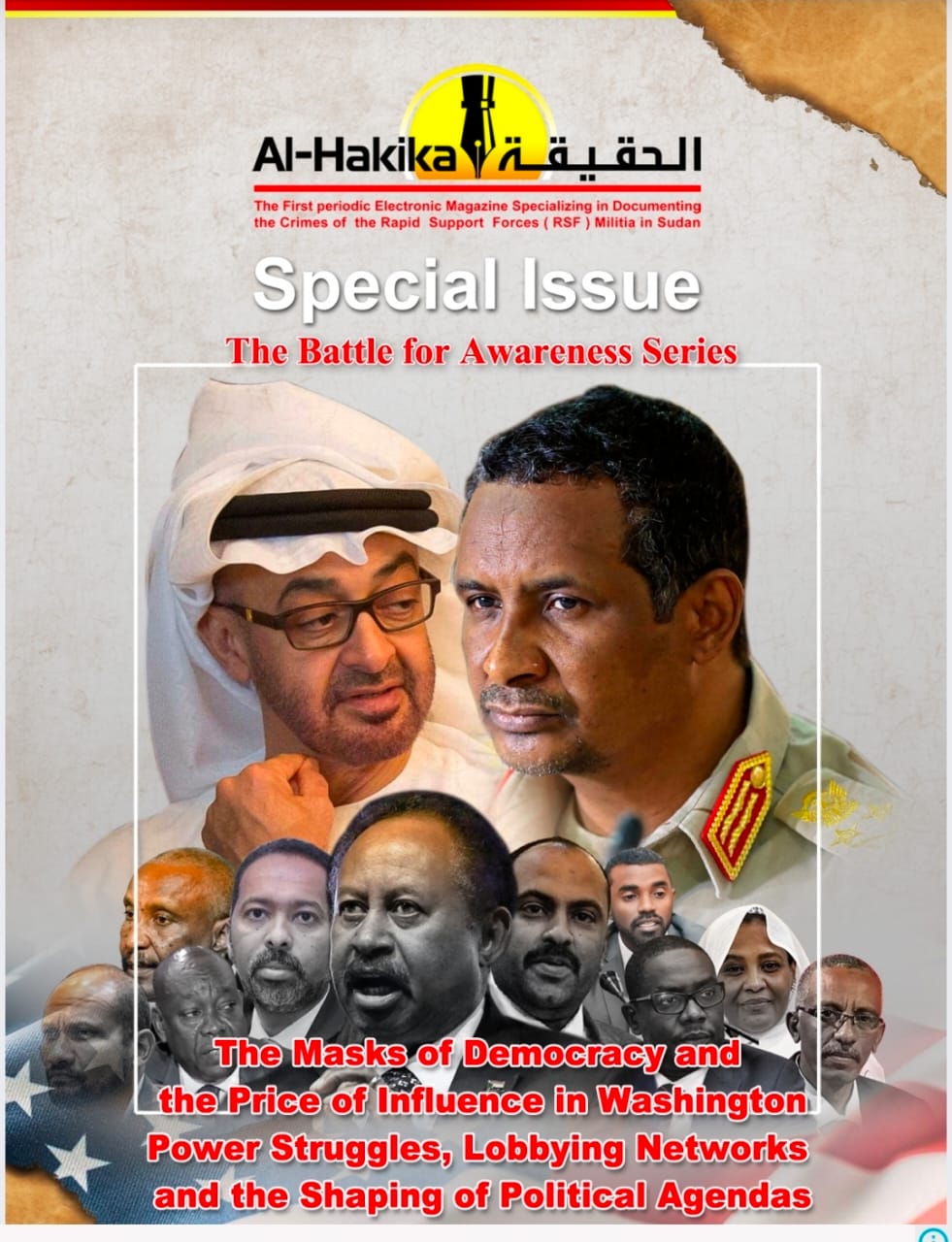
The Battle for Awareness Series The Masks of Democracy and Washington’s Bills: Power Struggles, Lobbying Networks and the Engineering of Agendas

Al Hakika
The Battle for Awareness Series
The Masks of Democracy and Washington’s Bills: Power Struggles, Lobbying Networks and the Engineering of Agendas
Introduction
As Sudan’s humanitarian tragedy deepens and violations by the UAE-funded Rapid Support Forces (RSF) militia spread, another fierce battle unfolds, openly and covertly, over political agendas, purchased international influence and back-channel diplomacy.
African affairs expert Cameron Hudson’s documented remarks about Washington lobbying contracts costing up to US$80,000 a month raise pressing questions. Who pays the bill? Whose interests does this purchased influence serve? How are Western public relations firms enlisted to conceal RSF violations amounting to war crimes and crimes against humanity, while rehabilitating alliances professing independence and transparency?
I. The Political Economy of Lobbying and Influence in Washington
Western capitals, particularly Washington, are centres of an industry devoted to shaping perceptions through intertwined financial and organisational mechanisms:
Public Relations Networks and FARA Contracts: Foreign-agent registration laws facilitate substantial expenditure on public relations and lobbying firms, which draft policy papers and organise hearings to influence American decision-makers.
Shaping Narratives and Misleading Western Opinion: These firms craft language downplaying RSF crimes and depicting the war as a conflict between equally culpable parties, stripping abuses against civilians of their legal and moral significance.
Financing Logistics and Diplomatic Missions: Contracts cover luxury travel, hotel accommodation and private conferences for leaders of the Somoud and Taqaddum civilian alliances. These activities are promoted as support for democratic transition, while remaining under the direction and supervision of their regional financiers.
II. Foreign Funding and the Engineering of Political Decisions
Beyond logistical assistance, foreign funding becomes an instrument for controlling political decisions and orientations through:
Buying Loyalties and Recycling Elites: Direct funding maintains selected politicians’ financial backing and media prominence, presenting them internationally as the sole representatives of civilian forces.
Regional Reputation Laundering: These alliances serve as a civilian and political cover to absolve Abu Dhabi and ease international pressure, particularly following reports documenting its involvement in supplying the RSF with weapons and military equipment through air and land routes.
The Erosion of National Independence: Complete financial dependence compromises political autonomy, subordinating delegations’ activities to donors rather than the demands of the Sudanese people.
III. Accountability and the Civilian Alliances
The conduct of Somoud and Taqaddum leaders raises profound national and ethical concerns, particularly their detachment from Sudan’s humanitarian catastrophe. Preoccupied with meetings and foreign tours, they largely disregard the displacement, destitution and hunger Sudanese citizens endure daily because of the RSF militia’s armed rebellion aimed at seizing power.
Opacity and Moral Evasion: These alliances deliberately avoid naming perpetrators or classifying their crimes under international law, protecting their interests and ties with supporting parties.
Spreading Rumours and Misleading Narratives: They have promoted what the report characterises as false allegations concerning the use of chemical weapons and the Muslim Brotherhood, seeking to demonise the national army and undermine its role in defending Sudan’s territorial integrity and sovereignty.
IV. Media Narratives and International Mechanisms
Scrutiny of these alliances’ financial arrangements and media discourse reveals a widening gap between their claims and documented international reports. Transaction-tracking tools and international contract databases indicate that lobbying and media funds flow through intermediary networks and institutions covering delegations’ actual expenses, rather than transparent channels. Financial disclosure is thus virtually absent, challenging their professed transparency.
Their media discourse employs vague formulations that avoid directly condemning the RSF’s regional support networks. Meanwhile, United Nations fact-finding bodies and Security Council experts present what the report describes as compelling photographic and numerical evidence of continued arms and equipment shipments through air and land routes overseen by Abu Dhabi.
These delegations also use international forums and United Nations organisations to advance particular political demands instead of highlighting violations of international law. Mechanisms intended to secure justice and protect civilians thus become arenas for political bargaining and shielding the principal party responsible for these abuses.
V. The National Battle for Awareness
Historic turning points demand a firm stand against political dependence and its dangers to the future of the state:
Unmasking Appealing Slogans: Claims of “civilian rule” and “democracy” can no longer obscure foreign funding intended to serve external interests incompatible with national sovereignty.
Restoring National Will and Sovereignty: Safeguarding Sudan and its institutions requires understanding vested-interest networks and public relations firms, and affirming that national legitimacy comes from standing with the people and their institutions, not from the political salons of Western capitals.
A lasting solution to Sudan’s crisis will emerge neither from Washington’s public relations offices nor from deals financed by regional power blocs, but from the Sudanese people’s unwavering commitment to their sovereignty and national institutions, and the exposure of those trading in their suffering on the international market for influence.
Public Pressure and Political Embarrassment
Throughout the travels of Somoud delegations, described as foreign proxies, Sudanese communities abroad confronted them at public forums and on the streets. In the United States, Canada and across Europe, demonstrators challenged them with difficult questions and blocked their paths, chanting in support of “One Army, One People” and rejecting the militia and its agents in the United Arab Emirates, Chad, Ethiopia and elsewhere.
