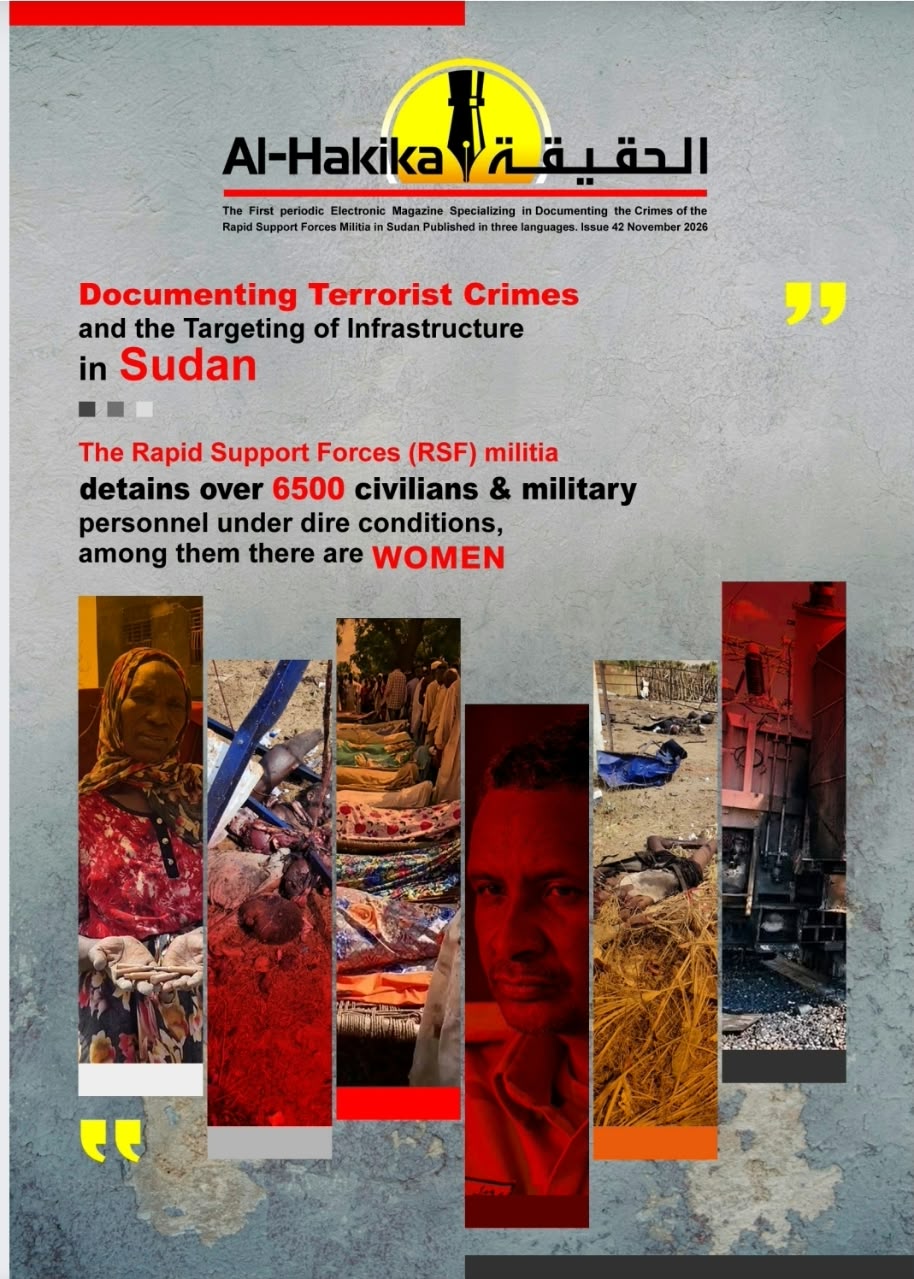
Another bloody page from the record of violations by the Rapid Support Forces, featured in issue 42 of Al-Haqدkika Magazine

*Introduction*
The forty-second issue of *Al-Haqiqa* magazine unveils yet another harrowing chapter in the record of atrocities and horrific crimes committed by the terrorist Rapid Support Forces (RSF) against the Sudanese people. This edition serves as a comprehensive documentary reference for the international community and United Nations human rights mechanisms. It sheds light on catastrophic events—meticulously documented—ranging from the inhumane siege and detention of over 6,500 civilians in El Geneina under dire conditions, to the infernos in El Fasher and El Geneina and the discovery of mass graves. It further details the systematic bloodshed in Kordofan, characterized by drone strikes and summary executions, alongside the deliberate starvation of the population through the imposition of extortionate levies and the targeting of humanitarian aid convoys. In the face of this terrorist arrogance, a robust diplomatic and legal response has emerged—both from within Sudan and internationally. This includes the efforts of Ms. Salima Ishaq in Geneva to protect Sudanese women and combat sexual violence; the diplomatic battle at the UN Human Rights Council, which saw the extension of the Fact-Finding Mission’s mandate—a move met with firm Sudanese opposition due to the mission’s overreach and selectivity; the dismantling of transnational networks and the exposure of covert foreign interference facilitated by clandestine air-cargo routes; and the strengthening of national resilience through the continued opening of the Adré border crossing to deliver aid to those in need. These field and humanitarian efforts complement broader strategic visions—such as those articulated at the El Alamein Strategic Summit—aimed at safeguarding national security, consolidating the rule of law, fostering recovery, advancing the constitutional process, and fulfilling the directives given to Sudanese ambassadors to strengthen the nation’s diplomatic presence and protect its sovereignty and stability.
* Al-Haqiqa Documenting *
*Documenting Terrorist Crimes and the Targeting of Infrastructure in Sudan*
October 2026
The brutal crimes and systematic violations committed by the terrorist (RSF) militia and their backers against the Sudanese people continue. These acts reflect a criminal audacity, deliberately aimed at starving and terrorizing civilians, while destroying the essential infrastructure upon which life in the country depends. Recent events on the ground reveal a dangerous and significant escalation, manifested in brutal attacks carried out by the militia using the-suicide drones. These strikes targeted shelters, camps for displaced persons, and defenseless civilians in the Blue Nile region—specifically in the Abu Shandi area and Mashra’ al-Qarya 6 in Wad al-Mahi locality. The attacks resulted in the deaths of 31 people and left dozens of others—including women, children, and the elderly—wounded. The victims were engaged in their traditional livelihood activities, such as artisanal gold mining, to secure their daily sustenance. Concurrently, the systematic destruction of the Umm Darfa Hospital and vital water infrastructure has rendered these facilities completely inoperable. This has triggered the forced displacement of more than 2,800 individuals and hundreds of destitute families from ten villages toward the Roseires locality and other areas—a flagrant violation of United Nations charters, the Geneva Conventions, and international humanitarian law.
The assaults did not stop there; they escalated into a comprehensive, destructive war targeting vital infrastructure across various states. The militia launched a series of airstrikes that knocked the Al-Markhiyat electrical substation in Omdurman out of service, plunging large areas of the capital into darkness. This followed the targeting of five other major substations in the states of Al-Qadarif, Sinnar, Al-Jazirah, and White Nile—specifically the Al-Hawata, Al-Faw, Singa, Mashkour, and Al-Junayd stations. These attacks caused severe damage to equipment, led to a blackout across the southeastern power grid, and threatened the stability of the national grid. The resulting disruption has crippled medical services, drinking water pumping stations, telecommunications networks, and economic activities, while also complicating reconstruction efforts in areas where residents have begun to return.
In this context, the Deputy Director of the Military Intelligence Authority revealed, during a press conference in Khartoum, documented figures confirming that 162 drone attacks were launched from within Ethiopian territory—specifically from bases in Asosa and Bahir Dar, as well as locations near the border. These attacks claimed the lives of more than 400 civilians and 102 military personnel, and resulted in the destruction of dozens of hospitals, schools, and fuel stations in cities including Ad-Damazin, Singa, Kosti, Rabak, and El-Obeid. The military official confirmed that the attacks involved advanced loitering munitions (kamikaze drones) and long-range unmanned aerial vehicles, several of which were successfully intercepted and shot down by the Armed Forces. These attacks coincide with ongoing regional military and logistical support provided by the United Arab Emirates—a fact substantiated by reports from the UN Fact-Finding Mission and the UN Security Council Panel of Experts, and further exposed by human rights organizations and international journalistic investigations into networks facilitating the recruitment of mercenaries and the supply of advanced weaponry and equipment. In the face of these persistent massacres and assaults—which coincide with the first anniversary of the El Fasher massacre—the Government of Sudan reiterates its condemnation of these atrocities, crimes against humanity, and war crimes. It holds the terrorist militia and its backers fully criminally liable, while calling upon the international community and the UN Security Council to fulfill their legal and moral responsibilities. Furthermore, the Government of Sudan reaffirms its inherent right to self-defense and to protect its citizens and national assets through all legitimate means.
* Al-Haqiqa Documenting *
* the Rapid Support Forces (RSF) militia detains over 6,500 civilians and military personnel under dire conditions, among them there are women*
Sudan Doctors Network has revealed that it has obtained documented information indicating that more than 6,500 individuals—both military personnel and civilians—are being held in various detention sites in the city of El Geneina, West Darfur, which is under the control of the Rapid Support Forces (RSF) militia.
The list of detainees includes 709 women—most of whom were taken from the city of El Fasher following the militia’s seizure of the city in October 2025 and subsequently forcibly transferred to El Geneina—as well as approximately 500 children under the age of eighteen.
According to the network, these insecure detention sites are located at the former UNAMID mission headquarters, the 15th Infantry Division headquarters, and Ardamata Prison—all areas under the control of the militia and its allies since November 2023.
Sudan Doctors Network has issued urgent warnings regarding the dire deterioration of health conditions and severe food shortages within detention centers—a situation that threatens to trigger major health and humanitarian catastrophes, endangering the lives of thousands of civilians, including women and children.
*Alhaqiqa Documenting *
*The Inferno of El Fasher and El Geneina: Mass Graves and Brutal Detentions*
October 2026
Horrifying footage circulating online, showing mass graves between El Fasher and Tawila, has revealed a genocide committed by the Rapid Support Forces (RSF) militia. The violence has resulted in thousands of deaths, occurring amidst a siege and a campaign of ethnic cleansing that followed the fall of El Fasher in October 2025. In a related development, the Sudan Doctors Network reported the death of humanitarian volunteer El-Tayeb El-Tom Mursal while in the militia’s custody at Shala Prison in El Fasher. He was one of more than 3,000 detainees currently enduring catastrophic conditions, lethal abuses, and deliberate medical neglect. Regarding the displacement crisis, Adam Regal, spokesperson for the Coordination for Displaced Persons and Refugees, confirmed that thousands of people fleeing toward Tawila are facing extreme humanitarian hardship and famine. Meanwhile, community protection networks have documented instances of rape and brutal sexual violence against displaced women fleeing the outskirts of El Fasher.
The militia’s abuses have extended further, targeting medical personnel; Dr. Mubarak Bishara Ahmed, for instance, has been held in detention since being seized from his home in El Geneina weeks ago, with no justification provided for his arrest. In the face of these horrific crimes, the Sudan Doctors Network has issued an urgent appeal to the international community and human rights organizations, calling for immediate pressure to uncover the fate of those detained, grant humanitarian and medical teams access to detention centers, secure the release of civilians, and hold the militia’s leaders and members accountable for their violations and crimes.
*Alhaqiqa Documenting*
*The Blood of Displaced Persons and Civilians in Kordofan: Between Drone Strikes and Summary Executions*
October 2026
The Rapid Support Forces (RSF) militia continues to commit the most heinous crimes and flagrant violations against humanity in North Kordofan State. In a dangerous escalation aimed at terrorizing defenseless civilians and ethnically cleansing the region—all amidst a suspicious international silence—the rebel militia carried out a horrific massacre. They targeted the Sheikan dormitory at the University of El-Obeid—a site serving as a shelter for thousands of displaced people fleeing the horrors of the war—with a drone. The attack, which struck while families and children were asleep, resulted in the deaths of five civilians and left dozens more with varying degrees of injury. Furthermore, the militia continues to target residential neighborhoods, public service facilities, and educational institutions with targeted drone strikes, further increasing the toll of casualties and causing extensive damage to the property of citizens. The series of atrocities did not stop there; the hand of treachery reached the “Umm Badir” area, where 23 unarmed civilians were subjected to a mass summary execution. They were shot dead in cold blood—blindfolded and with their hands bound—under flimsy pretexts. The incident was captured on video, revealing to the entire world the most heinous forms of ethnic cleansing and intimidation, which have forced thousands of residents to flee their homes. This situation places an urgent moral and legal responsibility upon the international community, the United Nations, and human rights organizations to condemn this terrorist militia, hold the perpetrators accountable, and ensure they do not escape justice—while simultaneously providing urgent medical and humanitarian support to the victims and those affected.
*Alhaqiqa Documenting *
*The Rapid Support Forces (RSF) continue to target aid convoys and impose extortion levies in Kordofan and Darfur*:
October 2023
The humanitarian crisis in Sudan is worsening due to the systematic practices of the Rapid Support Forces (RSF), who are targeting food aid shipments and relief convoys belonging to the United Nations and various humanitarian organizations in the states of South Kordofan and North Darfur. These violations occur at a time when millions of Sudanese people are facing the threat of food shortages.
*Repeated attacks in South Kordofan*:
South Kordofan State has witnessed persistent attacks targeting World Food Programme (WFP) convoys. At dawn on Saturday, October 3, 2026, trucks carrying humanitarian aid—clearly marked to indicate their humanitarian purpose—were struck by an aerial drone attack launched by the Rapid Support Forces (RSF) militia. The incident occurred while the convoy was traveling between the cities of Dilling and Kadugli, resulting in the death of one driver, injuries to others, and the destruction of life-saving food supplies. This attack is part of a series of assaults documented by the United Nations Office for the Coordination of Humanitarian Affairs (OCHA), which has reported that approximately 17 aid trucks have been damaged and 8 drivers killed over the past two years.
Forced Detention and Financial Extortion in Darfur
*In the Darfur region*: The Rapid Support Forces (RSF) militia intercepted 32 World Food Programme (WFP) trucks—intended to provide relief to families affected and besieged by the militia across various localities in the region—in the Kutum locality, and forcibly diverted them to the city of El Fasher. Furthermore, the militia demanded large sums of money as “levies” and ransoms in exchange for the release of the detained trucks. Such actions obstruct humanitarian efforts and threaten the lives of hundreds of thousands of people who rely entirely on this aid.
These ongoing violations amount to war crimes, as they involve the use of food as a weapon to starve the civilian population. This situation necessitates urgent international intervention to pressure the Rapid Support Forces to ensure the establishment of safe corridors and to cease all attacks against humanitarian personnel and organizations.
*Alhaqiqa Documented*
*Militia Leader’s Participation Under a Pseudonym Sparks Outrage Among the Sudanese Community in the Netherlands*
October 2026
In a serious breach of European security and diplomatic protocols, a video investigation by the Dutch broadcaster NOS has revealed that Al-Goni Dagalo—brother of the Rapid Support Forces (RSF) militia leader and a figure currently under U.S. sanctions for his involvement in arms deals that fueled ethnic cleansing against civilians—managed to infiltrate a peace conference held in The Hague in late 2024. Dagalo deceived the organizers by using a false identity, “Ahmed Musa,” to participate in panel discussions at Erasmus University. His true identity was eventually exposed during the event, and footage of his participation was later exploited by the militia for ideological and propaganda purposes. This has further intensified the anger and mobilization of the Sudanese community in Europe against such a high-risk security breach.
While the “The Hague Projects for Peace” foundation expressed deep regret—placing the blame on an organizational partner that provided the misleading information—and the host academic institution declared that it would have barred such an individual had his identity been known in advance, the most significant scandal lies in the response of the Dutch Ministry of Foreign Affairs. The Ministry admitted that it was aware of Dagalo’s presence on the day of the conference, yet it failed to take any action to notify the police or judicial authorities. The Ministry justified its inaction by noting that the individual held a valid three-year, multiple-entry Schengen visa and that there were no formal arrest warrants issued against him. At that time—before the European Commission later addressed the crisis by officially including Al-Gony Dagalo on its list of stringent sanctions and imposing a comprehensive entry ban against him across the entire territory of the Continental Unions.
*Alhaqiqa Documenting*
*Salima Ishaq Discusses Protecting Sudanese Women and Combating Sexual Violence in Geneva*
October 2026
Salima Ishaq, Head of the Advisory Office for Women and Children, met with the head of the United Nations Population Fund (UNFPA) office in Geneva to strengthen cooperation on protecting women, reducing maternal mortality, and addressing human rights violations—specifically the use of sexual violence as a weapon of war. During her participation in the Geneva Peace Forum, Ishaq emphasized that the economic empowerment of women and the support of their productive capacities are fundamental pillars for Sudan’s recovery and reconstruction in areas of return. For her part, the UN official welcomed the government’s institutional approach, affirming the UNFPA’s readiness to provide technical support and mobilize resources for priority programs. The meeting concluded with both sides underscoring the importance of continued UN coordination to bolster the resilience of Sudanese women and address the requirements of the national recovery phase.
*Alhaqiqa Documenting *
*International Justice Put to the Test of Selectivity: UN Human Rights Council Extends Fact-Finding Mission Mandate Amid Firm Sudanese Rejection*
October 2026
In a move reflecting the complexities of the international diplomatic landscape regarding the crisis in Sudan, the UN Human Rights Council—during its 63rd session—adopted draft resolution A/HRC/63/L.26. The resolution extends the mandate of the “Independent International Fact-Finding Mission for the Sudan” for an additional year. It passed with 28 votes in favor, 10 against, and 9 abstentions—a decision that highlights a clear divide in international positions, as… It garnered support from European nations, as well as groups from South America and Asia—with the notable exceptions of India and Thailand. Conversely, firm opposition emerged from a bloc of Arab, Islamic, and African states, including China, Cuba, and Vietnam, alongside Pakistan, Indonesia, and representatives of the Arab Group—namely Qatar, Kuwait, Iraq, and Egypt—as well as Burundi. Most African capitals, led by Ethiopia, opted for a “gray area” by abstaining, while The Gambia and South Africa chose to support the UN-led initiative. This decision was met with categorical rejection and sharp criticism from Sudan’s Permanent Representative to the United Nations in Geneva, Ambassador Hassan Hamid Hassan. He articulated a resolute national stance—one that the UN system disregarded by persistently sidelining the fundamental reservations raised by the Khartoum government. The Ambassador denounced what he termed an ethically and legally unacceptable equivalence between the Sudanese Armed Forces—which are fulfilling their core constitutional duty to protect the state and safeguard its sovereignty—and a rebel militia implicated in grave violations against civilians. He further emphasized that the protection of human rights remains a paramount national priority, one that requires no external tutelage—especially when such oversight ignores existing national mechanisms, such as the Office of the High Commissioner, the expert on the human rights situation, and the Panel of Experts established under UN Security Council Resolution 1591. All of these mechanisms enjoy the full cooperation and acceptance of the Sudanese government, which, immediately upon the outbreak of the conflict, took the initiative to establish an effective national framework for accountability and the prevention of impunity: the National Committee for the Investigation of Crimes and Violations of National Law. …and international humanitarian law, pursuant to Resolution No. 143 of 2023 issued by the Chairman of the Transitional Sovereignty Council—a body that has already submitted five interim reports to the Council. Sudan has, throughout the past three years, consistently demonstrated a full readiness to implement the principle of complementarity, whereby any external mechanism would serve to complement—rather than replace—the work of the national commission, while also strengthening Sudan’s own judicial legacy. However, the drafters’ failure to include an explicit provision guaranteeing this principle, coupled with their refusal to address Sudan’s substantive reservations, exposes the true nature of these resolutions; they are far from equitable and fail to address the root causes of the cr
