Al-Haqiqa Reveals Secret Gold-Plundering Networks Supplying Weapons to the Rapid Support Forces Militia

Awa: Al-Haqiqa Reveals Secret Gold-Plundering Networks Supplying Weapons to the Rapid Support Forces Militia
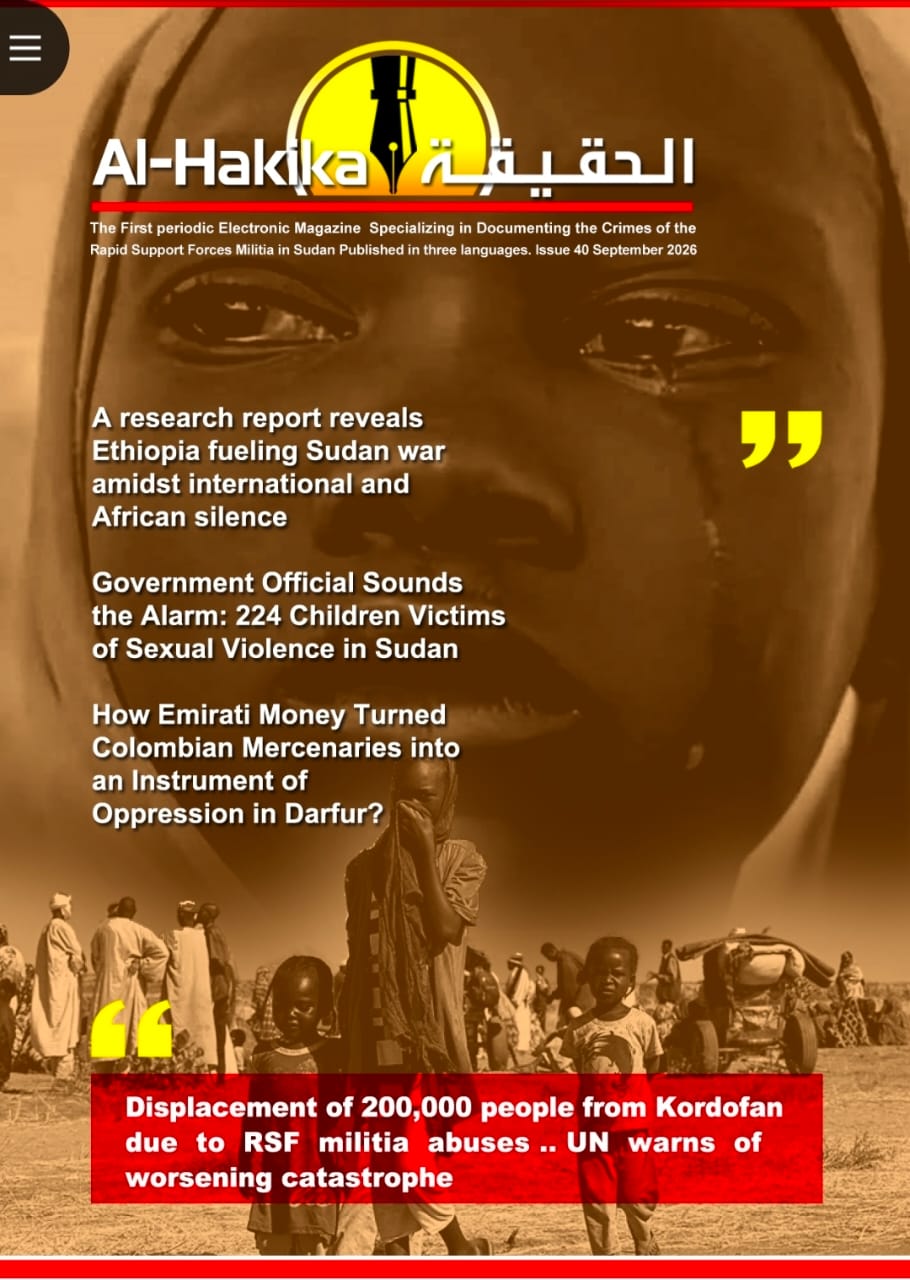
Al-Haqiqa magazine wraps up its 40th issue at a pivotal moment in Sudan’s history, as the humanitarian tragedy escalates and transcends national geographic boundaries to reveal a complex network of regional and international interests that fuel the fires of war and drain the blood and resources of the Sudanese people.
In this issue, the magazine continues to fulfill its mission as a documented periodic online reference available in three languages. It presents clear evidence and stark facts to international mechanisms and institutions concerned with human rights regarding the systematic crimes and violations committed by the Rapid Support Forces (RSF) militia.
The magazine offers an in-depth analytical reading of how smuggled gold and Sudan’s looted wealth have been transformed into a lifeline that sustains the war machine through secret aviation networks and cross-border companies, backed by regional and international leverage and facilities. The research reports in this issue dissect the roles played by certain neighboring countries and the complicity of silence stemming from economic balances, reaching political debates and direct accusations concerning the arming of the militia and the recruitment of mercenaries to displace civilians in Darfur and the wider region.
Furthermore, Al-Haqiqa highlights the ongoing tragedy in Kordofan and its northern regions, tracking waves of forced displacement affecting hundreds of thousands, alongside practices of detaining civilians and extorting their families, which have turned into a systematic trade, in addition to UN documentation detailing the destruction of the education sector and its institutions. These documentations expose the extent of international double standards that turn a blind eye to the blood of victims in Sudan while handling other cases with resolve.
This issue is not merely a journalistic account of violations; it is an indictment of historical significance and a moral responsibility that places the international community and judicial institutions before a crucial test: either triumph for the values of truth and justice, or succumb to influential interests. Al-Haqiqa opens a new page of rigorous documentation to remain the voice of the victims, a witness to the tragedy, and a caller for prompt justice that does not expire with the passage of time.
Al-Haqiqa
Issue No. 40 – August 2026
Introduction
*Al-Haqiqa* magazine marks its 40th issue at a pivotal moment in Sudan’s history. The humanitarian tragedy is escalating, transcending national borders to expose a complex web of regional and international interests that fuel the war and drain the blood and resources of the Sudanese people. In this issue, the magazine continues its mission as digital, reliable and trilingual reference, presenting international human rights mechanisms and institutions with irrefutable evidence and objective facts regarding the systematic crimes and violations committed by the Rapid Support Forces (RSF) militia.
The magazine offers an in-depth analytical look at how smuggled gold and looted Sudanese wealth have become a lifeline sustaining the war machine through covert air networks and transnational corporations, all backed by regional and international influence and facilitation. Research reports in this issue dissect the roles played by certain neighboring states and the complicit silence driven by economic calculations, extending to political debates and direct accusations regarding the arming of the militia and the recruitment of mercenaries to target civilians in Darfur and the wider region.
*Al-Haqiqa* also sheds light on the unfolding tragedy in Kordofan and its northern areas, tracking waves of forced displacement affecting hundreds of thousands. It highlights the detention of civilians and the extortion of their families—practices that have morphed into a systematic trade—alongside UN documentation detailing the destruction of the education sector and its institutions. These records expose the double standards of the international community, which turns a blind eye to the bloodshed in Sudan while addressing other issues with firmness. This issue is not merely a journalistic record of violations; it is a historic indictment and a moral imperative that confronts the international community and judicial institutions with a pivotal test: either to uphold the values of truth and justice or to remain beholden to the interests of power. “Al-Haqiqa” opens a new chapter of rigorous documentation, remaining the voice of the victims—a witness to the tragedy and an advocate for swift justice that is not subject to a statute of limitations.
*Al-Haqiqa Documents*
*A research report reveals Ethiopia fueling Sudan war amidst international and African silence:*
August 26, 2026
The Humanitarian Research Lab at Yale University has revealed significant military movements and escalation at the Ethiopian army base in the city of Assosa—located near the Sudanese border—between August 23 and 28. These developments occur amidst mounting accusations that Addis Ababa continues to provide logistical and military support to the Rapid Support Forces (RSF) militia, all while the African Union and the United States maintain a stance of silence and indifference.
Images and data obtained by the lab confirmed an unprecedented surge in military equipment at the base, *with the following observed:*
▪︎ 100 new 4*4 vehicles distributed across three staging areas (a sixfold increase over normal levels), including five vehicles mounted with heavy weaponry and 15 armored personnel carriers.
▪︎ The arrival of five massive vehicle transporters and 14 trailers—transport capacity sufficient to mobilize a fully equipped ground force of 750 to 1,000 troops.
▪︎ 15 supply containers and 8 new trucks, alongside the completion of a 70-meter-long strategic storage hangar, in addition to 60 shipping containers spotted in the area since last June.
These complex field movements along Sudan’s eastern borders raise serious questions regarding the nature of Ethiopia’s role in fueling the war. Meanwhile, the international community and the African Union face widespread criticism for their lack of a decisive stance on the military supplies that are exacerbating the humanitarian crisis and prolonging the conflict in Sudan.
*Al-Haqiqa Documenting *
*Sudan’s Looted Gold: How Smuggled Wealth Fuels the War with Emirati Influence*
August 2026
A report published by the platform “Firstpost” reveals the modern-day exploitation of crises, highlighting the pivotal role of Sudanese gold smuggling in financing the bloody conflict and the direct support the Rapid Support Forces (RSF) militia receives through trade networks managed by the UAE.
Citing an investigation by the *Financial Times*, the report details that at least 1.5 tons of stolen gold—valued at approximately $100 million—were smuggled into the UAE following the outbreak of the initial hostilities.
The wave of looting began with the Rapid Support Forces (RSF) militia seizing the government gold refinery in Khartoum and the Central Bank. Gold bullion was then smuggled across borders into Chad and South Sudan before being shipped to Abu Dhabi on Emirati commercial and military aircraft.
Although official Sudanese gold production reached approximately 70 tons in 2025, the vast majority of this wealth leaks out through smuggling routes. International research centers—foremost among them Chatham House—confirm that “conflict gold” has become a financial lifeline, directly funding arms deals and military operations for armed militias.
Foreign ambitions extend beyond mere material gain from resources; Sudan occupies a strategic position within a network of trade, ports, and influence overlooking the Red Sea and the Horn of Africa.
Accusations against the UAE go beyond the direct purchase of gold to the sponsorship of complex networks involving armed factions, resulting in a deadly equation: *illicit gold flows in one direction, while lethal weapons stream in the opposite direction.*
*Al-Haqiqa Documenting *
*A Secret Aviation Network and Foreign Mercenaries Fuel the War in Sudan*
August 2026
An investigative report by Reuters—based on a draft report by the UN Panel of Experts tasked with monitoring the arms embargo on Darfur—revealed the involvement of a private aviation network managed by a former US military contractor. This network supported RSF military operations via a secret air corridor linking Chad, Libya, and Somalia. The investigation revealed that former US Special Forces soldier Stephen Shaulis leads a network of security and logistics companies that operated three Boeing 727 and 737 aircraft. These planes conducted covert night flights designed to evade radar and tracking systems. They transported heavy weaponry, drones, and hundreds of mercenaries from N’Djamena Airport in Chad to logistics hubs in Nyala (Darfur) and other locations, prior to the destruction of one of the network’s aircraft in May 2025 while it was transporting Rapid Support Forces (RSF) militia elements.
UN documents also highlight the involvement of between 1,500 and 2,000 Colombian mercenaries—known as “Desert Wolves”—recruited through the Emirati security firm GSSG to operate drones and provide military planning for the Battle of El Fasher. While Reuters has not recorded any official link to the allegations against Shaulis or the imposition of sanctions on him to date, and reactions from the parties involved have varied, the United Nations has confirmed violations of the arms embargo and deliberate attempts to conceal these operations.
*Al-Haqiqa Documenting*
*Displacement of 200,000 people from Kordofan due to RSF militia abuses; UN warns of worsening catastrophe:*
August 2026
The UN’s International Organization for Migration (IOM) revealed the displacement of over 200,000 people across the Kordofan region due to widespread abuses by the Rapid Support Forces (RSF) militia. The organization noted continuing waves of flight in the Blue Nile and Darfur states—driven by deliberate shelling and the destruction of essential services—coinciding with seasonal flooding. In an official statement, the organization reported a 25% increase in displacement rates in the Sheikan locality of North Kordofan, which is now sheltering approximately 105,000 displaced persons—the majority of whom are concentrated in the city of El Obeid.
The organization warned of the dire humanitarian consequences resulting from the militia’s targeting of infrastructure—specifically the shelling of El Obeid’s main electrical transformer, which paralyzed hospitals, water networks, and telecommunications—as well as the escalating risks posed by persistent attempts to encircle the city and besiege civilians.
The impact of these violations has extended to the Qaysan area in Blue Nile State and to West Darfur. Meanwhile, flash floods and heavy rains have exacerbated the suffering of hundreds of families in the Tawila locality and North Darfur, leaving more than 715,000 displaced persons facing extremely harsh humanitarian conditions amidst a lack of shelter and essential services.
*Al-Haqiqa Documenting*
*Government Official Sounds the Alarm: 224 Children Victims of Sexual Violence in Sudan*
August 2026
Sudan’s State Minister for Human Resources and Social Welfare revealed to *Sudan Tribune* that 224 cases of war-related sexual violence against children have been documented since the conflict began. She emphasized that these figures represent only a fraction of the true scale of the disaster due to social stigma, fear, and insecurity—particularly in areas controlled by the Rapid Support Forces (RSF).
In shocking detail, five girls aged between 6 and 14 suffered severe violations resulting in grave injuries that require complex surgical interventions.
The Ministry and social experts have condemned this as an unprecedented erosion of moral standards and a destructive weapon used to humiliate communities and tear apart their social fabric. Warnings have been raised regarding the psychological and social scars that haunt survivors, depriving them of their right to education and a safe life amidst the collapse of protection institutions and a persistent culture of impunity.
*Al-Haqiqa Documenting *
*UN Documents RSF Militia’s Destruction of Sudan’s Education Sector*
August 2026
The war in Sudan continues to claim the future of an entire generation, as educational institutions have been transformed from centers of learning into battlegrounds and military bases. Against this backdrop, UN Deputy Secretary-General Amina Mohammed presented the UN Security Council with irrefutable evidence and documentation proving the RSF militia’s involvement in systematic, grave violations against the education sector—acts that amount to war crimes.
UN reports have documented shocking figures, including the following violations:
*Direct Attacks*: More than 67 attacks directly targeting educational facilities have been recorded. *Military Exploitation*: 154 documented cases of schools and educational institutions being converted into military barracks, detention centers, and militia operations headquarters across Khartoum and Al-Jazira states, as well as the Kordofan and Darfur regions.
*Total Deprivation*: More than 8 million Sudanese children have dropped out of the education system, amidst the near-total paralysis of education in Darfur; school closures reached 97% in North Darfur, with operations also halted in the southern and western parts of the region.
Converting civilian objects and educational facilities into military barracks is not merely the destruction of infrastructure; it is the systematic assassination of the present and future of Sudan’s children.
*Al-Haqiqa Documenting *
*How Emirati Money Turned Colombian Mercenaries into an Instrument of Oppression in Darfur?*
August 2026
The myth of an “internal” war in Sudan is crumbling in the face of stark facts revealed in a bombshell investigative report by *Financial Times* journalist Catherine Horelld.
The conflict is no longer merely a dispute between local parties; it has become an exposed theater for a transcontinental mercenary network—orchestrated by Emirati funds and cross-border security networks—where the blood of the Sudanese people has been reduced to a commodity in the market for regional influence. The investigation revealed a complex logistical route extending from the jungles of Colombia and private security hubs there, through training bases in the UAE (such as the Ghiyathi base in Abu Dhabi), to staging points in Bosaso, Somalia, and Kufra, Libya, ultimately concluding in the heart of Darfur—specifically the cities of Nyala and El Fasher.
Approximately 2,000 Colombian mercenaries—including former special forces personnel and ex-members of drug cartels—were deployed to support the Rapid Support Forces (RSF) under the cover of the Emirati company Global Security Services Group (GSSG).
The evidence goes beyond verbal testimony, encompassing digital signals, phone data, and records of covert flights with transponders switched off. It also includes seized phones set to Spanish, documenting the fighters’ direct movement from Abu Dhabi to El Fasher. There, these mercenaries operated drones, radars, and air defense systems, and trained children as young as twelve—sending them into a slaughterhouse without any understanding of the cause or objective.
The horrific nature of this scheme is laid bare in the firsthand accounts of the mercenaries themselves—testimonies that document crimes against humanity rather than mere military battles. These accounts range from the desolate streets of El Fasher—reeking of death and littered with the bodies of women and children crushed by military machinery—to torture centers at Nyala Airport, where human beings were annihilated amidst unbearable screams. Field realities and digital analyses by the Conflict Insights Group have demonstrated that the tragic fall of El Fasher and the ensuing horrific massacres were the direct result of funding, training, and logistical support orchestrated by Abu Dhabi. This investigation not only exposes the mechanism by which Sudan was transformed into an open arena for war profiteers and private security companies, but also confronts the world with a stark reality—bitterly summarized by a Colombian mercenary: “Emirati money buys a lot of consciences.” While mercenary networks reap profits from the fruits of destruction, it is the Sudanese people who pay the heaviest price in a conflict deliberately turned into an international blood-for-profit trade.
Al-Haqiqa documents
Amnesty International Calls on Brussels to Halt Arms Sales to the UAE to Stop the Sudan War
August 21, 2026
Amnesty International sent a strongly worded letter to European Commission President Ursula von der Leyen, calling on the European Union and its member states to move immediately from merely condemning the Sudan crisis to taking concrete punitive measures against the United Arab Emirates (UAE), given its role as the most prominent external backer of the Rapid Support Forces (RSF) militia.
The organization urged Brussels to impose a comprehensive arms embargo on Abu Dhabi and to condition any future trade agreements or strategic partnerships on an end to fueling the conflict and a commitment to strict human rights standards.
In its letter, the organization emphasized that the atrocities and crimes against humanity witnessed in the city of El Fasher and areas of North Darfur—including killings, ethnic cleansing, rape, and sexual enslavement—would not have occurred without the continuous flow of weapons and military equipment from the UAE. It warned that a similar scenario of genocide currently threatens the city of El Obeid amidst escalating drone attacks and the siege imposed upon it.
Amnesty International stressed that the arms embargo must remain in place until Abu Dhabi provides credible guarantees against re-exporting the weapons and holds accountable those involved in past violations of the UN arms embargo. It also urged the EU to include explicit clauses in free trade agreements allowing for their immediate suspension in the event of human rights violations, while simultaneously supporting the deployment of an international protection force and extending the mandate of the UN fact-finding mission to ensure perpetrators do not escape accountability.
*Al-Haqiqa Documenting*
*North Kordofan: Detention of civilians and extortion of their families becomes a systematic racket for the Rapid Support Forces (RSF) militia*
August 2026
In a flagrant violation of the rules of international humanitarian law and the Universal Declaration of Human Rights, arbitrary practices and systematic abuses against unarmed civilians in North Kordofan State continue at the hands of Rapid Support Forces (RSF) militia members.
Local sources and documented testimonies from victims’ families report that a desert patrol belonging to the RSF militia—under the command of field commander “Ibrahim Al-Tom”—detained approximately 13 merchants and citizens from the town of “Marshing” in South Darfur. The detention occurred while they were transporting shipments of tobacco crops en route to the Northern State.
*Detention Sites:* The victims were forcibly transferred and detained in private homes converted into unofficial detention centers in the “Hamrat Al-Sheikh” and “Abu Za’ima” areas.
*Extortion and Financial Demands:* The militia demanded a ransom of 20 million Sudanese pounds per individual; following negotiations conducted under duress, this was reduced to 10 million pounds per person, subject to a strict deadline for payment.
*Threats of Cruel Treatment:* Militia members threatened to transfer the detainees to the “Daqris” detention center—located west of Nyala and notorious for mistreatment and grave abuses—should they fail to pay the demanded sums. **Widespread Phenomenon and Ongoing Violations**
Field testimonies confirm that this incident is not an isolated event; rather, it reflects a persistent pattern and a lucrative business model targeting travelers and those fleeing areas under militia control. The detained victims hail from various regions, including:
*Kordofan and Darfur regions:* (Rahad Al-Birdi, Tawila, Kabkabiya, Mellit, Saraf Omra, and Zalingei).
These practices constitute war crimes and crimes against humanity, involving:
▪︎ Arbitrary detention and enforced disappearance without any legal basis.
▪︎ Hostage-taking and financial extortion—acts explicitly prohibited under the 1949 Geneva Conventions and their Additional Protocols.
▪︎ Restriction of freedom of movement and the targeting of objects and civilians not participating in hostilities.
***Al-Haqiqa* Documents**
**Complicity through Silence… How Britain’s Economic Interests Shield UAE-Backed Networks in the Sudan War**
August 2026
Documented reports and evidence have revealed a stark gap between the British government’s diplomatic awareness and the reality on the ground in Sudan. Intelligence documents and data indicate that London possesses direct evidence proving the existence of supply lines and operational links between the United Arab Emirates and the Rapid Support Forces (RSF)—evidence met with a government silence that prioritizes protecting economic ties over halting crimes against civilians. These developments have exposed Britain to widespread criticism from human rights and political circles, particularly following leaks and testimonies from international experts and researchers. These sources confirm that foreign policy officials in London prefer to avoid publicly disclosing evidence of Abu Dhabi’s involvement, fearing “retaliatory measures” that could harm the massive investment and trade partnerships between the two nations.
International expert Nathaniel Raymond, a researcher at Yale University, noted that technical data retrieved from the phones of Rapid Support Forces (RSF) members revealed undeclared air movements between Addis Ababa and Abu Dhabi via military aircraft. Although British officials acknowledged the value of this data as conclusive evidence of logistical support, the British government has refraine
