The Weapon of Cross-Border Starvation: How does the Rapid Support Forces turn humanitarian aid into a pipeline of death in Sudan?

*Al-Haqiqa Magazine*
*Issue No. 41 – August 2026*
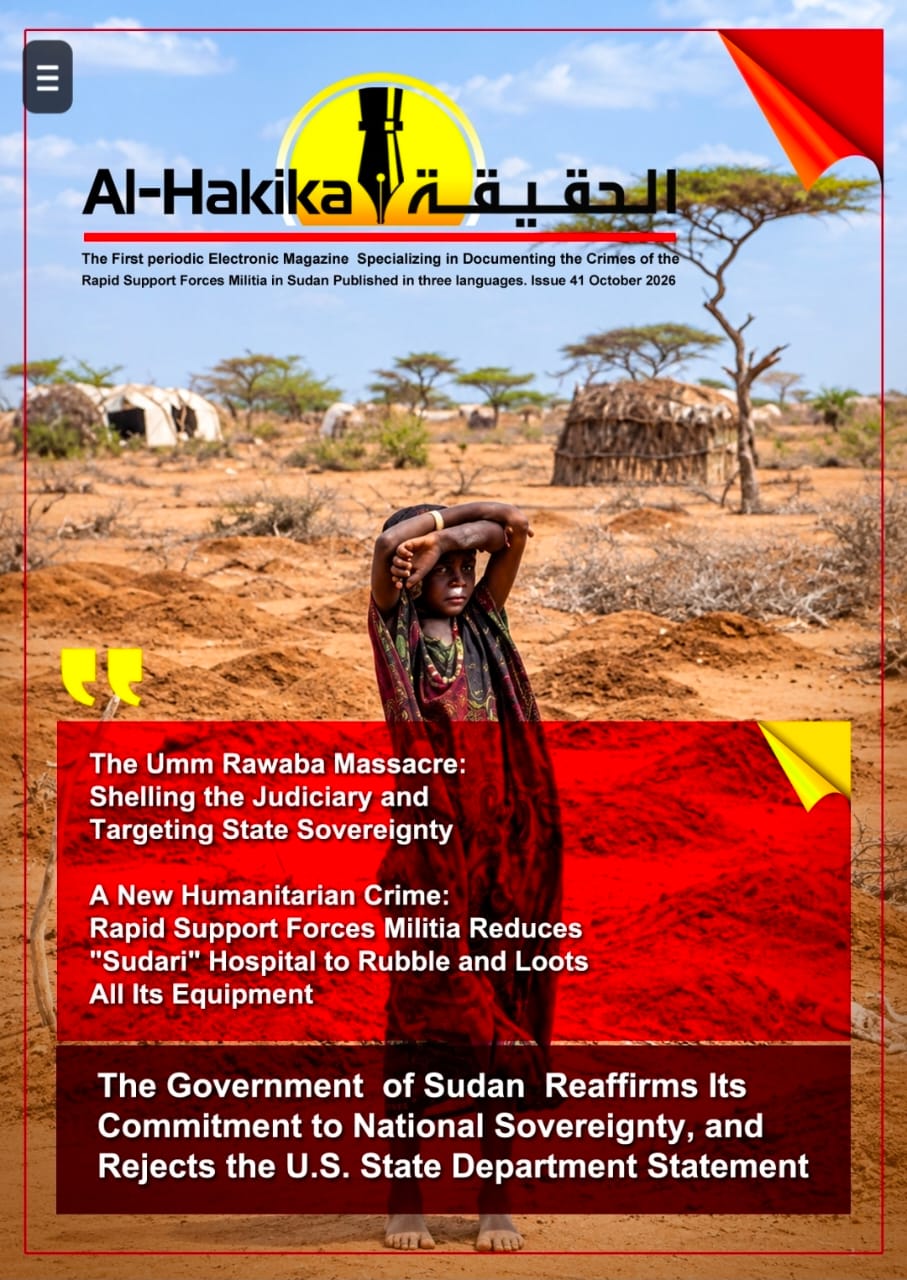
The release of the forty-first issue of *Al-Haqiqa* magazine comes at a pivotal moment where the will for national steadfastness converges with the promising signs of recovery and the reclaiming of the initiative. This issue paints a comprehensive picture documenting Sudan’s fateful battle across all its dimensions—field, political, humanitarian, and security-related. As the illusions of tutelage crumble and the masks of international double standards fall away—confronted by the steadfastness on the ground, the valor of the Armed Forces, and the legitimate leadership’s commitment to national sovereignty—the systematic criminal practices of the Rapid Support Militia are simultaneously exposed. These actions go beyond the targeting of civilian infrastructure and judicial institutions—as exemplified by the massacre of the judiciary in Umm Rawaba and attacks in North Kordofan—extending to the use of cross-border starvation tactics and the withholding of humanitarian aid as instruments of war and leverage. This occurs against the backdrop of violations that have imposed harsh humanitarian conditions on the regions of Darfur and North Kordofan.
Furthermore, this issue documents evidence of the nation’s pulse returning to life, manifested in the historic return of over five million citizens to their homes and Khartoum’s strategic shift from relief efforts toward the horizons of economic recovery and reconstruction. This runs parallel to a high-level intelligence and security presence in international forums, which exposes mercenary economic networks and the techniques of covert, encrypted warfare. The issue also highlights key documentary and political themes, including: “Khartoum and the Quintilateral Mechanism: Red Lines on Sovereignty and the Engagement of National Will,” addressing the limits of coordination and the rejection of external dictates; and “The Return of Sovereignty from the Heart of Khartoum: The Republican Palace Reclaims Its Diplomatic Stature and Launches a Phase of Consolidation,” documenting the Palace’s restoration of its sovereign symbolism and the resumption of ambassadorial credential ceremonies. Furthermore, it covers “High-Level Diplomatic Activity in New York: The Foreign Minister Breaks the Media Blockade and Leads the Battle for National Sovereignty at the UN,” detailing the breaking of international isolation and the mobilization of support within the halls of the General Assembly.
*Al-Haqiqa* magazine presents this comprehensive dossier to readers and international organizations, reaffirming its role as a steadfast authority on human rights and media. It chronicles the events of the “Battle of Dignity” and documents the resilience of the Sudanese people and their legitimate institutions in safeguarding sovereignty, building the future, and upholding the rule of law.
*Documenting the Truth*
*Analysts and Experts: “Field Realities Shatter Illusions of Tutelage and Strip Away Washington’s Masks”*
September 2026
Political analysts and legal experts have asserted that Washington’s obstruction of an entry visa for the Chairman of the Sovereignty Council—and Commander-in-Chief of the legitimate military institution—reflects a moral collapse, further exacerbated by blatant double standards. According to these experts, the move clearly exposes the bankruptcy of U.S. policy and its jarring bias; it draws a false equivalence between the official state institution—waging an existential battle to defend its sovereignty and the nation’s resources—and a rebel militia that thrives on foreign support and feeds on destruction.
Political observers emphasize that attempts to stifle the national voice and block access to international platforms will neither obscure the reality on the ground nor weaken the resolve of a state defending its dignity, nationhood, and sovereignty. Legitimacy, the experts maintain, is derived from the homeland’s soil, the valor of the armed forces, and the steadfastness of a proud people; it neither awaits recognition contingent upon an entry visa nor requires the corridors of New York to prove its existence.
Analysts unanimously agree that the masks have indeed fallen, and that the slogans of international law have crumbled at the altar of narrow politicization. They point out that the resonance of truth is not exhausted by speeches delivered in closed halls; rather, the land—purified by the blood of martyrs and reclaimed through the heroism of the legitimate army in the trenches of dignity—is what speaks today with a voice of steadfastness and sovereignty. Experts view this voice as more eloquent, powerful, and enduring than any United Nations podium.
The Truth Documented*
*The Government of Sudan Reaffirms Its Commitment to National Sovereignty, Views Respect for Legitimate Institutions as the Cornerstone of Any Peace Process, and Rejects the U.S. State Department Statement*:
September 2026
The Republic of Sudan, through a statement issued by the Ministry of Foreign Affairs and International Cooperation, affirmed its categorical rejection of the statement issued by the U.S. State Department on September 22, 2026. It emphasized that respect for national sovereignty, the preservation of the country’s unity, and adherence to the legitimacy of its institutions constitute non-negotiable principles in any initiative seeking to achieve a just and sustainable peace.
The statement explained that the rebellion by the Rapid Support Forces (RSF) militia on April 15, 2023, marked a pivotal turning point that impacted regional and international security. It noted that most of the the world’s nations and peoples have recognized the magnitude of the grave injustice inflicted upon Sudan and its people—except for a limited group that chose to adopt misleading narratives and disregard undeniable facts.
The Sudanese Foreign Ministry highlighted that the government engaged positively and responsibly in the Jeddah negotiation rounds—generously sponsored by the Kingdom of Saudi Arabia and the United States of America. These negotiations resulted in substantive commitments and understandings that, had they been honored, would have contained the crisis at its inception and spared the Sudanese people from humanitarian disaster and destruction. However, the rebel militia chose to renege on those pledges and persist in its systematic crimes, remaining beholden to the agendas and desires of external parties. The statement also noted that the Sudanese government responded with great flexibility and dynamism to US efforts within the “Quartet” framework, despite its legitimate and publicly stated reservations regarding one of the parties linked to supporting the conflict and fueling the insurgency through the provision of arms, funding, and mercenary recruitment—as documented in numerous international reports. The Government of Sudan maintains that no serious peace effort can achieve its objectives without cutting off sources of illicit support and halting the foreign interventions that prolong the conflict.
In this regard, the statement expressed Sudan’s appreciation for the vision presented by US President Donald Trump on November 19, 2025, concerning his administration’s direct engagement in efforts to end the war—in response to the initiative proposed by His Royal Highness Prince Mohammed bin Salman—a move that has revived the Sudanese people’s hopes for peace. The statement further affirmed Khartoum’s continued interest in President Trump’s vision and his reiterated assurances before the UN General Assembly (81st Session) regarding the necessity of decisive action to end conflicts and prevent their crises from spiraling out of control.
Conversely, the Government of Sudan emphasized its categorical rejection of the recent statement by the US State Department, calling upon Washington to engage in a positive and realistic manner consistent with its previous statements that explicitly acknowledged respect for Sudan’s sovereignty. It expressed its rejection of any stance equating the State and its legitimate institutions with the rebel militia, emphasizing that no political process should be exploited to legitimize the criminal reality imposed by force of arms, nor to reward the rebellion for its violations against citizens and the State.
The Ministry of Foreign Affairs reiterated that the Sudanese people’s vision is anchored in achieving a just peace that ends the existence of armed militias outside the State framework and ensures that arms remain exclusively in the hands of regular national institutions. This paves the way for a purely Sudanese-led political process that fulfills the citizens’ aspirations for freedom, democracy, justice, and the rule of law.
The Ministry concluded its statement by affirming that peace remains the Government of Sudan’s strategic choice and goal. It declared its full readiness to engage constructively with the United States and all international and regional partners—foremost among them the Kingdom of Saudi Arabia, the State of Qatar, the Arab Republic of Egypt, Russia, China, Turkey, Pakistan, the League of Arab States, the African Union, the Organization of Islamic Cooperation, IGAD, and the African members of the UN Security Council (A3)—to work sincerely and impartially toward halting the war and ending the conflict, in accordance with the principles of respect for national sovereignty and the free will of the Sudanese people and their legitimate institutions.
Al-Haqiqa Reports*
*High-Level Sudanese Participation in Baku Forum… General Intelligence Warns of Dangers Posed by “Mercenary Economy” and Encrypted Warfare Technologies; Reaches Understandings with Azerbaijan*
Baku – Al-Haqiqa (Reporting)
The “Baku Security Forum” opened in the Azerbaijani capital, Baku, running from September 21 to 23 under the theme: “Contemporary Challenges in the Global Security Architecture and Establishing Effective Cooperation Mechanisms to Combat Terrorism.” The high-level delegation from the Republic of Sudan—led by the Director General of the General Intelligence Service, Lieutenant General Ahmed Ibrahim Mufaddal—concluded its active participation in the forum, which was attended by heads and representatives of security and intelligence agencies from approximately 90 countries and international organizations.
In his comprehensive address to the forum, Lieutenant General Mufaddal emphasized that the current crisis in Sudan constitutes a critical test of the regional and international security architecture’s ability to confront the complex threats arising from the rebellion of the Rapid Support Forces (RSF) militia. He noted that the situation in Sudan exemplifies a dangerous pattern of transnational organized crime.
The Director of General Intelligence warned of the dire consequences resulting from the rebel militia’s systematic reliance on foreign mercenaries and the unregulated cross-border flow of weapons and equipment, stressing that these practices pose a direct threat to the security and stability of both the regional and international spheres. He also highlighted the growing danger posed by terrorist groups and militias exploiting modern technologies—particularly drones, encrypted communication platforms, and digital currencies—as contemporary tools for financing and managing terrorist operations and organized crime.
The head of the Sudanese delegation presented Khartoum’s security vision to the participants, calling on the forum to establish a flexible platform for information sharing and direct intelligence coordination. He urged the creation of integrated mechanisms to combat modern security threats through comprehensive approaches and the cutting off of terrorism financing sources. Furthermore, he advocated for the development of strict international legal frameworks to address the threat of drones, the dismantling of mercenary economic networks, and the strengthening of border management and security capabilities for conflict-affected nations.
On the sidelines of the forum, Lieutenant General Mufaddal held a series of productive bilateral discussions with the leadership of the Azerbaijani State Security Service. During these meetings, he provided a detailed briefing on the military and security situation in Sudan and outlined Khartoum’s perspective on current issues. The talks resulted in shared security understandings, paving the way for comprehensive bilateral cooperation and intelligence coordination between the Sudanese General Intelligence Service and its Azerbaijani counterpart.
The forum concluded with the issuance of a final statement, in which participants affirmed their commitment to translating all recommendations into concrete implementation mechanisms that contribute to safeguarding the security and stability of nations and peoples.
*Documenting the Truth*:
*The Umm Rawaba Massacre: Shelling the Judiciary and Targeting State Sovereignty*
September 2026
In a new crime added to the record of systematic terror, a drone belonging to the Rapid Support Forces (RSF) militia targeted judicial buildings in the city of Umm Rawaba, North Kordofan State. The attack resulted in 31 Sudanese citizens being killed or wounded, including six women.
This assault is neither an isolated incident nor a random targeting of individuals; rather, it is a deliberate strike against the prestige of the law and a direct attempt to dismantle the project of a justice-based state and judicial system in Sudan.
This direct shelling of the courthouse occurred just days before a UN Security Council session dedicated to discussing Resolution 1591 and coincided with parallel efforts to pass Bill HR1939 in the US Congress. Targeting judicial institutions sends a multitude of messages aimed at undermining justice, terrorizing civilians, destroying infrastructure, and eroding the foundations of national sovereignty. This targeting reflects a war strategy based on integrating battlefield escalation with international pressure. The militia deliberately strikes essential service facilities, judicial buildings, markets, and hospitals to sow widespread chaos. This situation on the ground is then exploited to renew international resolutions under the pretext of the state’s “inability to protect its citizens,” effectively turning UN resolutions into tools to economically and politically strangle Sudan. This occurs alongside attempts to cause internal fragmentation and distract the national stage with superficial debates, all while failing to explicitly condemn the crimes committed against institutions and civilian infrastructure.
*List of martyrs from the brutal, criminal shelling of the Civil Court in Umm Rawaba:*
▪︎ Martyr Luqman Mohammed Idris (Abu Bakr Al-Siddiq Neighborhood).
▪︎ Martyr Qaydum Daldoum (Southern District, Block 1).
▪︎ Martyr Amna Hassan Rabit (Al-Farouq Neighborhood).
▪︎ Martyr Mohsen Omar Adam.
▪︎ Martyr Jamila Azraq (Al-Baqir Neighborhood).
▪︎ Martyr Fatima Yusuf Al-Daqil (Abu Hamra Al-Mahatta).
▪︎ Martyr Al-Hadi Al-Ardan.
▪︎ Martyr Mohammed Hamza Ahmed (Umm Ush Al-Sheikh).
▪︎ Martyr Siddiq Fadlallah Mohammed Bashir.
▪︎ Martyr Maryam Mohammed Ahmed (Tayba).
▪︎ Martyr Mohammed Al-Fateh Mubarak.
▪︎ Martyr Abbas Mohammed Al-Hassan (Tendelti, Southern Neighborhood – Umm Rakouba Village). In the face of this direct targeting of governing institutions and national sovereignty, the requirements for a response entail: unequivocally condemning the Rapid Support Militia and pursuing legal action against it—both domestically and internationally—on the grounds that targeting judicial and civil institutions constitutes war crimes not subject to statutes of limitations; strengthening internal cohesion and maintaining a firm national stance in support of state institutions and sovereignty to counter agendas aimed at dismantling the state; and engaging the international community to expose and refute discriminatory decisions and schemes that exploit human suffering to pressure Sudan’s national will.
*Documenting the Truth*
*Tawila Under the Weight of Catastrophe… New Waves of Displacement Due to Rapid Support Forces (RSF) Violations: *
September 2026
The humanitarian tragedy in the Darfur region continues to expand with devastating consequences due to ongoing violations by the Rapid Support Forces (RSF). The town of Tawila, in North Darfur State, has faced a fresh humanitarian crisis with the arrival of approximately 3,407 newly displaced persons (comprising 634 families) since the beginning of September. They are fleeing the hellish attacks launched by the RSF against civilians across the state. Adam Regal, the official spokesperson for the General Coordination for Displaced Persons and Refugees Camps, revealed details of this harsh wave—which recently saw the arrival of an additional 121 families—noting that the vast majority of those fleeing belong to the most vulnerable groups: women, children, and the elderly. These individuals have endured the bitterness of repeated displacement—forced to flee their homes more than three times in succession from areas such as Turra, Dar al-Salam, Dar Sumayyat, Alawna, and Kafoud—before finally arriving in Tawila under harrowing circumstances.
Tawila has proven to be less of a safe haven and more of a stage for a slow confrontation with death; those who have fled encounter brutal humanitarian conditions, characterized by a near-total lack of food, alarming rates of malnutrition among children and mothers, and an acute shortage of medicines alongside the collapse of medical services. The journey is further compounded by a stifling water crisis that forces families to resort to contaminated and unsafe water sources. This situation is exacerbated by a complete lack of adequate shelter and sanitation facilities, compelling displaced persons to defecate in the open scenario that raises the alarm and threatens an imminent health disaster, including outbreaks of deadly diseases such as cholera, acute diarrhea, and typhoid.
Faced with this grim reality—stemming from the combined ravages of war, drought, and a scarcity of aid—the Coordination Body issues an urgent appeal to UN agencies and international humanitarian organizations. It calls for immediate intervention to save the lives of thousands of stranded families by providing emergency food baskets, medicines, and potable water, as well as establishing shelter tents and sanitation facilities. Furthermore, it urges the implementation of protection and psychosocial support programs to mitigate the impact of the greatest humanitarian crisis the region has ever faced.
*Documenting the Truth*
*The Cross-Border Weapon of Starvation: How the Rapid Support Forces Militia Turns Humanitarian Aid into a Conduit of Death in Sudan*
September 2026
Irrefutable evidence—gathered in field reports and UN investigations throughout 2026—points to the use of starvation as a systematic weapon of war. These reports document repeated attacks by the Rapid Support Forces (RSF) militia on humanitarian aid convoys—including trucks contracted by the World Food Programme (WFP) bound for conflict zones—as well as the direct obstruction of convoys heading to the cities of Dilling and Kadougli, and the seizure of therapeutic food shipments intended for malnourished children.
According to the latest UN report from September 2026, UN documents, flight tracking data, and satellite imagery reveal that these ongoing operations rely on a cross-border logistical and financial support network. This network exposes the involvement of individuals and companies linked to the UAE in financing and providing military support to the militia.
Targeting and destroying these shipments severs the last lifeline for hundreds of thousands of displaced persons and besieged families, transforming humanitarian aid from a means of salvation into a tool that deepens
